
This independent Betwinner India publication appears at betwinner2027.com. Brand references on these pages identify the subject of the information and do not establish any operator affiliation.
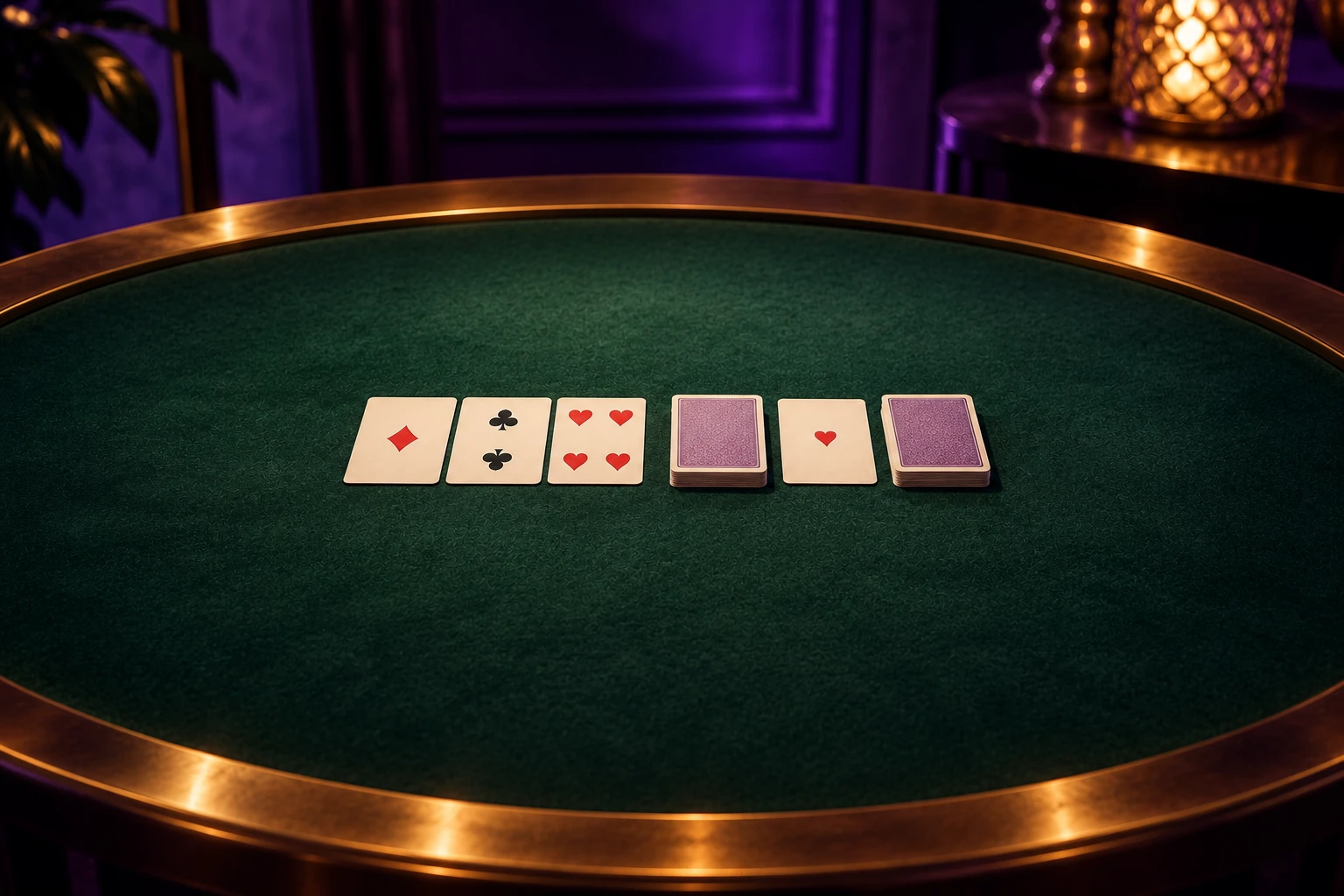
Picture a dark green table under a soft overhead light. Three cards lie in a tight row, their edges almost touching, and nothing else is on the felt. Now picture a second table: one card sits face up in the middle, and two small piles grow outward on either side of it, one to the left and one to the right. Then picture a third screen, where a person in a waistcoat is dealing cards by hand while a camera holds the table steady. Three scenes, three different kinds of attention. Each one is a way of sitting down at a casino table, and each asks something slightly different of the person watching.
Three cards, and the shape of a round
Teen Patti is a three-card format. That single sentence carries most of what the category is. A round is built from three cards per participant, and the round resolves by comparing what those three cards amount to. The comparison is the engine, and the small hand is the whole stage on which it happens.
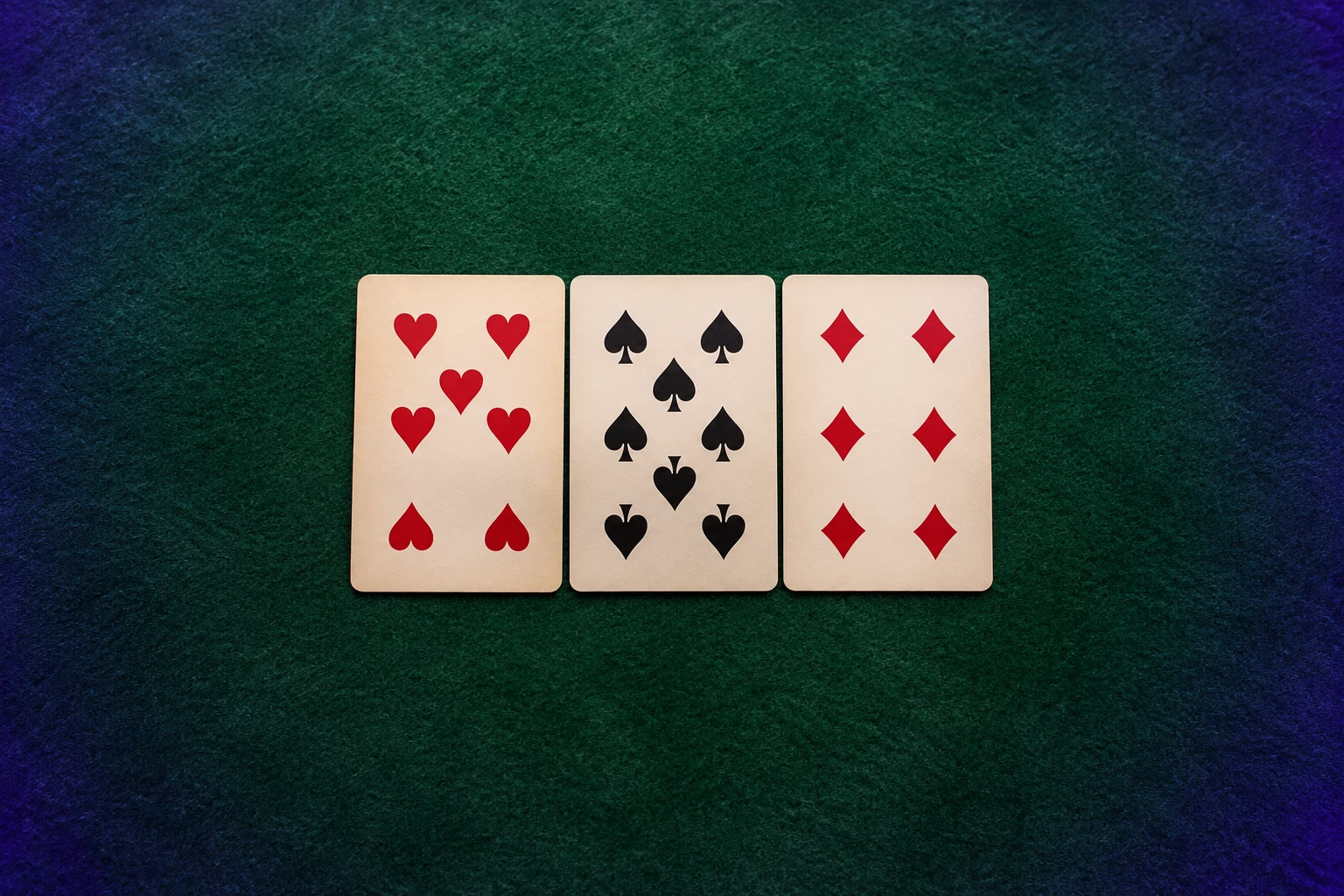
Think about what three cards look like on a table. They occupy a space no wider than a hand. There is no long row to scan and no growing pile to keep track of. The cards arrive, they sit there, and the round turns on what they are. That compactness gives the format its visual signature: a tight cluster, a moment of resolution, a fresh deal. A player can take in the whole composition in a glance, which is an aesthetic quality rather than an advantage of any kind.
The reference card and the slow unfolding
Andar Bahar is organised around a different idea, and the difference shows on the table immediately. One card is dealt face up and becomes the reference card. It stays there, fixed, while cards are dealt to two sides, Andar and Bahar. The round resolves when a card matching the reference card’s value appears on one of those sides. That is the core mechanic: a reference value, two places a match can appear, and a wait.
The wait is the texture of the format. A match can arrive early in the deal, when the two piles are still thin. Or the piles can keep growing for a while, card after card landing without the reference value showing up. Round length varies, and that variability is what gives Andar Bahar its particular feel. One deal can be over almost before you have settled; the next can stretch on while the two sides build.
Visually, everything radiates from the centre. The reference card sits face up and unchanging, and the two piles accumulate on either side of it like sediment. The growing piles are the progress of the round made visible, but only in the sense that they show how many cards have already been dealt. A taller pile does not signal that a match is near, because the value could still be several cards away. What the layout offers is a clear record of what has happened so far, arranged around a still point.
There is a calm to the arrangement. The centre stays fixed while the edges keep changing, so the eye has somewhere steady to rest even as the table moves. Each new card lands beside the last, and the shape of the round grows outward from the middle. The layout keeps the centre clear while the cards spread outward, and the quiet middle gives the whole table a sense of order.
A person, a camera, a broadcast
Live dealer is a separate category, listed apart from the card games, and it is different in kind from both of the formats above. In general terms, the format combines a real dealer or game host with a video broadcast, and the game in question may involve cards, a wheel or dice. The human presence is the defining feature. Someone is physically dealing or spinning, and a camera carries that action to your screen.
A live table is watched as much as it is played. The broadcast shows the physical handling of the game: cards being squared, chips being moved, a host working through the table. Those details are not part of the rules, but they are a large part of why the format exists. The human presence at the centre of the picture gives the table a rhythm that an image or symbol cannot quite match.
The contrast with slots is useful for understanding what live dealer is. Slots and similar products use random number generators to produce outcomes, and the symbols on the reels display those outcomes; the paytable describes what the symbols mean for that particular title. A live dealer game is built differently: a person acts, and a broadcast carries the action. Neither approach is more legitimate than the other. They are simply constructed in different ways, and they feel different to follow.
Teen Patti and Andar Bahar are listed as card formats, while live dealer is listed separately. Both appear in the source material, but that does not establish that either named game is offered as a live table here. Each format stands on its own terms.
Different rhythms at the felt and on the screen
Set the formats next to each other and the rhythms separate cleanly. A slot round centres on the reels: the symbols land, the frame holds them, and the paytable describes what those symbols pay for that title. The movement is mechanical and repeating, spin after spin, with the reels as the fixed frame of attention.
In an Andar Bahar round the attention rests on the centre and then travels outward. The reference card holds the middle of the table, and the two sides spread away from it as the round continues. Where Teen Patti keeps everything gathered in a cluster, this layout opens up around a single still point. The difference is one of where the eye settles: inward on a tight group, or outward from a fixed centre.
A live table adds a human rhythm to that picture. Instead of a frame of symbols, there is a person handling the cards and a broadcast carrying the deal. The small irregularities of anything done by hand give the table its character, and that presence is what sets a live table apart from an automated one, whichever game is being played.
None of these rhythms is better than another. They suit different moods and different amounts of time. Someone who wants a quick, self-contained moment will find a different table appealing from someone who wants to watch something build, and different again from someone who wants a person on the other side of the screen. The casino keeps them as separate categories so each can be chosen on its own terms. The home page is the starting point for all of them, and the slots area sits alongside as its own world of reels and paytables.
It is also worth remembering that the site serves more than casino play. The cricket side is a separate interest entirely, and card play and cricket are organised so that each can be found without being compared to the other. Knowing which kind of round you want to follow is more useful than knowing which category is largest.
Adult leisure, a budget, and a clear head
All of this sits inside a simple frame. These are games of chance, played for entertainment by adults, and the pleasure is in the table itself: the three-card cluster, the growing piles beside a reference card, the dealer’s hands on a broadcast. Chance decides how each round turns out, and the formats are there to be enjoyed rather than solved.
That is why a budget belongs at the start rather than the end. Deciding in advance what an evening is worth, and treating that figure as the cost of the entertainment rather than as a stake to be recovered, keeps the whole thing in proportion. The money spent is the price of the time at the table, in the same way a cinema ticket is the price of the film. When the budget is gone, the evening is over, and the next one starts fresh.
Betwinner is for adults aged 18 and over, and T&C apply. Play within your means.